Tuesday, May 18, 2010

Greece - Pt 1

We stayed at the Athens Gate Hotel, a lovely hotel in an excellent location near the Plaka area. It has a fantastic view of the Acropolis from its rooftop restaurant - see views below.


The Plaka is the historic centre of Athens and remains the oldest continuously inhabited area of the city. It is full of shops, tavernas and tourists. See a general view and a taverna we ate at below.


One night we dined on local dishes of moussaka and stuffed tomatoes at Ydria, a local restaurant in the Plaka - see below.


In the Plaka is a little 12th century church called Panagia Gorgoepikoos ("The Madonna Who Swiftly Hears"). Often called the Little Cathedral. See pic below.


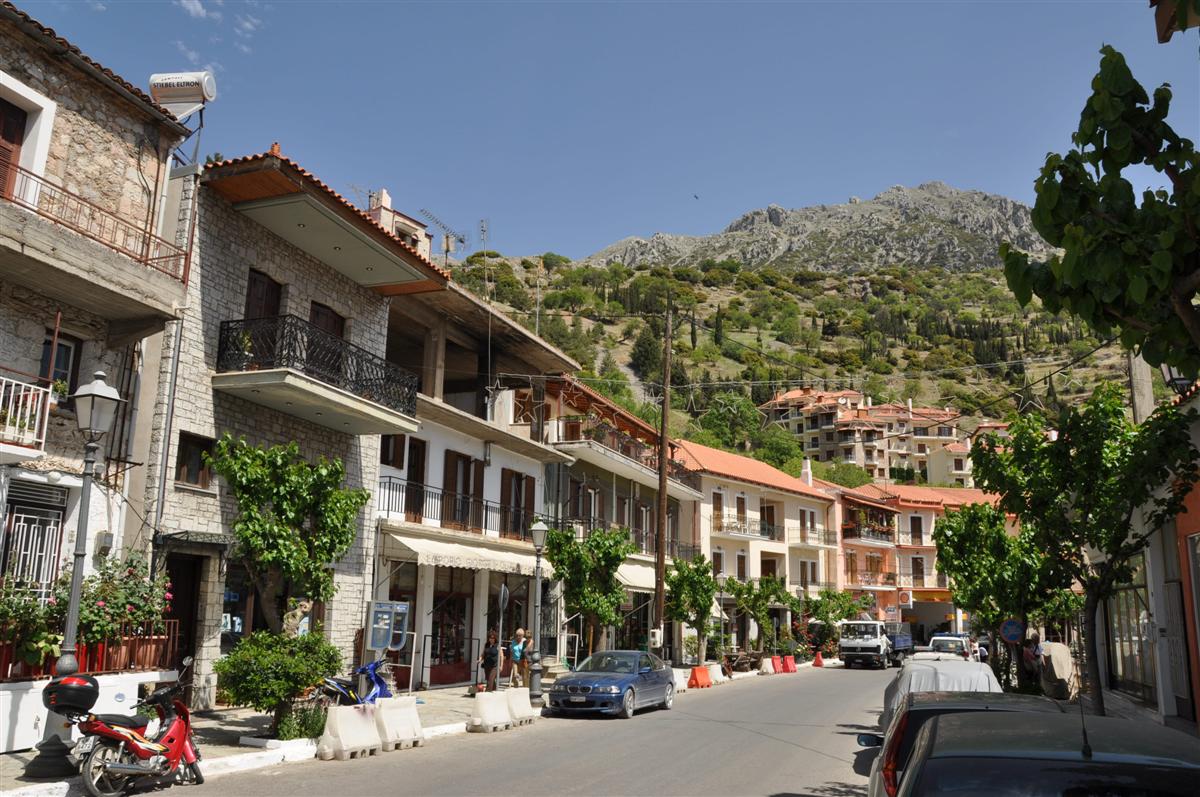
We did a one day bus trip to Delphi, passing through the little village of Arachovia in the mountains. The bus stops in front of a souvenir shop from which very aggressive salespeople spring on the tourists.


In ancient times, Delphi was a major shrine of the god Apollo, and famous for the ambiguous utterances of the oracle of Delphi (hence the expression "a Delphic statement"). It was once considered to be the centre of the world, and the rock in the following picture was known as the Omphalos (The Navel of the Earth).


Delphi was the site of the treasuries of many of the Greek city states, due to the security of being in a sacred site. The restored Athenian Treasury building is in the pic below.


The Temple of Apollo was a major building on the site - see pics below. It is mostly ruined now, but must have been impressive in its time. A huge statue of Apollo stood nearby, of which only the base remains to remind of its size.


Delphi has a major museum devoted to items recovered from excavations. The pic below shows a frieze called The Battle of the Olympian Gods against the Giants.


We visited the Acropolis to see the ruined buildings (some of which are gradually being restored - the manner of this being a subject of some controversy). The pics below show the Parthenon and the Porch of the Caryatids.


Monastiraki is another historic area of Athens and takes its name from a little sunken monastry in the area. It has a flea market which we visited, selling everything from junk to jewellery. See pic of flea market and of local snack, "koulouri" (Greek bagel).


There are ancient ruins in the area (like most others). The pic below shows the Tower of the Winds, an unusual octagonal structure which was built as a water clock and weather vane in the 1st century BC.


Next update will cover the Greek Islands.

Monday, May 17, 2010

Turkey - Pt 3

Our tour ended with a few days back in Istanbul. We stopped at the Kircilar Leather Outlet, where we were given Turkish tea or wine or raki while we watched a fashion show. Gail bought one of their lovely soft sheepskin leather jackets (could not talk Don into one of course!). See Ruth of our tour group in the fashion show pic with a male model.


That night we went to a dinner and belly dance show at a local nightclub. Unlike examples in Australia, the Turkish belly dancers were slim and muscular and demonstrated amazing control of their stomach muscles.


Our last full day in Istanbul was jam-packed with events. First we visited the Blue Mosque (interior and exterior pics below), so named for its 21043 blue Iznik tiles on the inside (a special style made for sultans, no longer in production).


Then we visited the famous Aya Sofia (means Divine Wisdom). It was first a Byzantine basilica, then a mosque, now a museum. It is the largest ancient building in Istanbul. See its interior in following two pics.


Next was the Topkapi Palace, a walled city perched above the Bosphorus and the Golden Horn waterways. It was built in the 15th century as a residence for Ottoman sultans (some sultans never left the palace in their entire lives). After the Turkish Republic was established after World War 1, it became a museum. We joined a long queue to look at the Treasury, where some of the world's largest diamonds and emeralds are on display. The pic below is the entrance to Topkapi.


In Istanbul's Grand Bazaar, there are more than 4000 shops, cafes and tea houses. We had lunch there and Gail also haggled for a good price on a turquoise bracelet - from 120 to 55 Turkish lira. The following two pics are the entrance and interior of the Bazaar.

Later in the afternoon, we enjoyed a cruise on the Bosphorus waterway, past Ottoman palaces, mansions, fortresses and mosques. We passed a Starbucks said to have "the best view in the world"! The pic below shows the Domabahce Palace, the modern palace that the sultans moved into after they found Topkapi too old fashioned.


That night we ate dinner in historic Kumkapi Street, famous for its fish restaurants, very noisy but atmospheric, with travelling musicians and fat belly dancer. See Gail in centre of photo below.


The following morning our tour ended and we were able to sleep in (no 5.15am wake up call!). The tour was good value for money, our guide was the best and we thoroughly enjoyed every minute. It was a very intense week and we could not keep up the pace for any longer.
Next update will cover Greece.


Sunday, May 16, 2010

Turkey - Pt 2

We crossed the Dardanelles Strait from Asia to Gallipoli. We then drove to Anzac Cove to see the narrow strip of land where the Anzacs landed on 25 April 1915. Then on to Lone Pine, so named for the single pine tree on the summit, hence much fought over because it dominated the surrounding countryside. See pic of Don at Anzac Cove and Gail at Lone Pine, where there is a monument.

Saturday, May 15, 2010

Turkey - Pt 1

After many IT problems, our serious blog starts here.

We flew from Brisbane to Singapore to Dubai to Istanbul on 5 May, all uneventful flights. We had one free day in Istanbul, before starting our Insight guided tour. We first visited the New Mosque, one of the many mosques in Istanbul.


We walked across the Galata Bridge and along the wide pedestrian Istiklal Street, lined with shops, cafes, theatres, etc, to Taksim Square. This is a buzzing quarter of the city, with an old restored tram running along the street. We took the tram back and on the way found ourselves surrounded by a student demonstration.


The following day, we left on our tour. It took us first to the lovely little village of Cumalikizik, with traditional wooden houses and cobblestone streets and local women selling their homemade breads, jams and handcrafts.


Next stop was the city of Bursa. We visited the colourful Silk Market, where vendors try to lure you into their stores. The pic below shows some of the beautiful scarves for sale.


In Bursa, we visited the Grand Mosque, notable for its 20 domes and the fact that it has the biggest prayer area of any mosque in Turkey.


In all the mosques, women have to dress appropriately with a head scarf, hence the pic of Gail below.


We also visited the Green Mosque, so named because of the tiles inside it. It has a Mausoleum containing the tomb of the sultan who had the mosque built.


In Bursa, we stayed in a hotel which had a Turkish Bath. Don was adventurous enough to try it, but found it to be very disorganised and overrated. The Turkish Bath building, however, looked quite impressive lit up at night.


We visited or passed several cities mentioned in the New Testament, eg in the letters of St Paul and Revelation (remember the seven cities: Ephesus, Smyrna, Pergamon, Thyatira, Sardis, Philadelphia, Laodicea).

On our tour, we visited a number of archaeological sites, the first of which was the ancient city of Sardis. The pic below shows the gymnasium there. Parts of the walls have been reconstructed.


We continued to Pamukkale, where we saw the ruins of ancient Hieropolis (mentioned in St Paul's writings). The pic below shows the Greco-Roman theatre there.


Pamukkale is famous for its "Cotton Castle", a chalk-white array of limestone terraces with water cascading into scallop-shell basins. Our guide strongly advised us against walking on the slippery terraces - he wanted to get us through the trip in one piece!


We had a night-time swim in the thermal pools at our hotel in Pamukkale, the Pam Thermal. The pic below shows some of the pools which were in scallop-shell basins like the "Cotton Castle".


Our next stop was Ephesus, significant to early Christianity as well as to the ancient world. On a hill near the ancient city, we visited the House of the Virgin Mary, shown in the pic below. This is said to be the last place Mary lived (when John was looking after her, after Jesus died). The evidence is pretty dubious, but it certainly draws crowds of tourists!


We had an interesting visit to a Turkish Carpet Centre, where we enjoyed watching very skilled women weaving beautiful carpets, including ones made of silk. We even saw how they spin the silk thread off the silkworm cocoons. They gave us a free lunch of meat and cheese pita bread and Turkish tea while they tried to make a sale (Don was a bit worried at one point!) 


Finally, we got to the ancient city of Ephesus itself, an amazing place. We walked along the Marble Street, where St Paul and St John once walked, to the incredible Library of Celcus, both in the pic below.


The ancient latrine (public toilets) at Ephesus was interesting, with everyone sitting side-by-side. No toilet paper in those days, just sponges to share, which sat in a trench of running water in front of you. The pic below shows our wonderful tour guide, Saba, in the Latrine! 


We followed in Cleopatra's steps and walked down the Arcadian Way to the huge Amphitheatre of Ephesus. It holds 24,000 people and is still used for concerts today (Michael Jackson and Diana Ross have performed there).


Another archaeological site was Pergamon (called Bergama today). We visited the Acropolis (means "high city"), which included a number of temples and a library, said to have contained 200,000 volumes. In its day it was a competitor with the Great Library of Alexandria. The pic below shows some ruins on the Acropolis. 


Also at Pergamon, we visited the Asklepion ruins, probably the world's first medical centre. We saw treatment pools, which would have contained mud/honey/milk/aromatherapy liquids. Underground tunnels, in the pic below, were used for the "suggestion technique" - they would call through holes above, "You'll be fine!" Some things haven't changed!


Next stop was Homer's legendary city of Troy. We visited the ruins (there had been at least nine cities on the site) and saw an enormous reconstruction of the fabled wooden horse.


Gallipoli and more of Istanbul in the next updates.....